
Luzerne City Directory Holdings
Luzerne County historical directories are split between the Osterhout Free Library and the Luzerne County Historical Society, so a search should name both the community and the year wanted. The collections are historical publications, not a current resident register. They are useful for a past home or business address and for dated head-of-household leads. The Society's run is broadest across the county, while Osterhout lists several distinct municipal runs with different starting and ending years.
| Collection | Years held | Where to consult | Best use |
|---|---|---|---|
| Luzerne County Historical Society historic directory volumes | 1871–2004 | Bishop Library and Archives | Countywide historical name and address tracing |
| Osterhout Wilkes-Barre directories | 1884–present | Osterhout genealogy and local-history collection | Wilkes-Barre name and address leads |
| Osterhout Hazleton directories | 1937–present | Osterhout collection | Hazleton-area leads; the run is not comprehensive |
| Osterhout Nanticoke directories | 1887–1924 | Osterhout collection | Nanticoke historical addresses |
| Osterhout Pittston and Plymouth directories | 1887–1891 | Osterhout collection | Short runs that need supporting records |
The dates describe holdings, not proof that every resident appeared in every issue. A missing listing can reflect an incomplete edition, a spelling variant, or a change in the way a name was printed. Check adjacent years before drawing a conclusion. Note: Luzerne County is made up of many municipalities, so match the volume to Wilkes-Barre, Hazleton, Nanticoke, Pittston, Plymouth, or the relevant locality first.
Osterhout's Luzerne Directory Runs
The Osterhout Free Library genealogy collection lists the municipal directory runs and local-history materials that make its shelf a practical first stop. Its Wilkes-Barre series begins in 1884 and continues to the present. The library also identifies the Hazleton, Nanticoke, Pittston, and Plymouth runs in the table above. Osterhout cautions that its printed volumes are not comprehensive, so use an entry as a dated lead rather than a final identity finding.
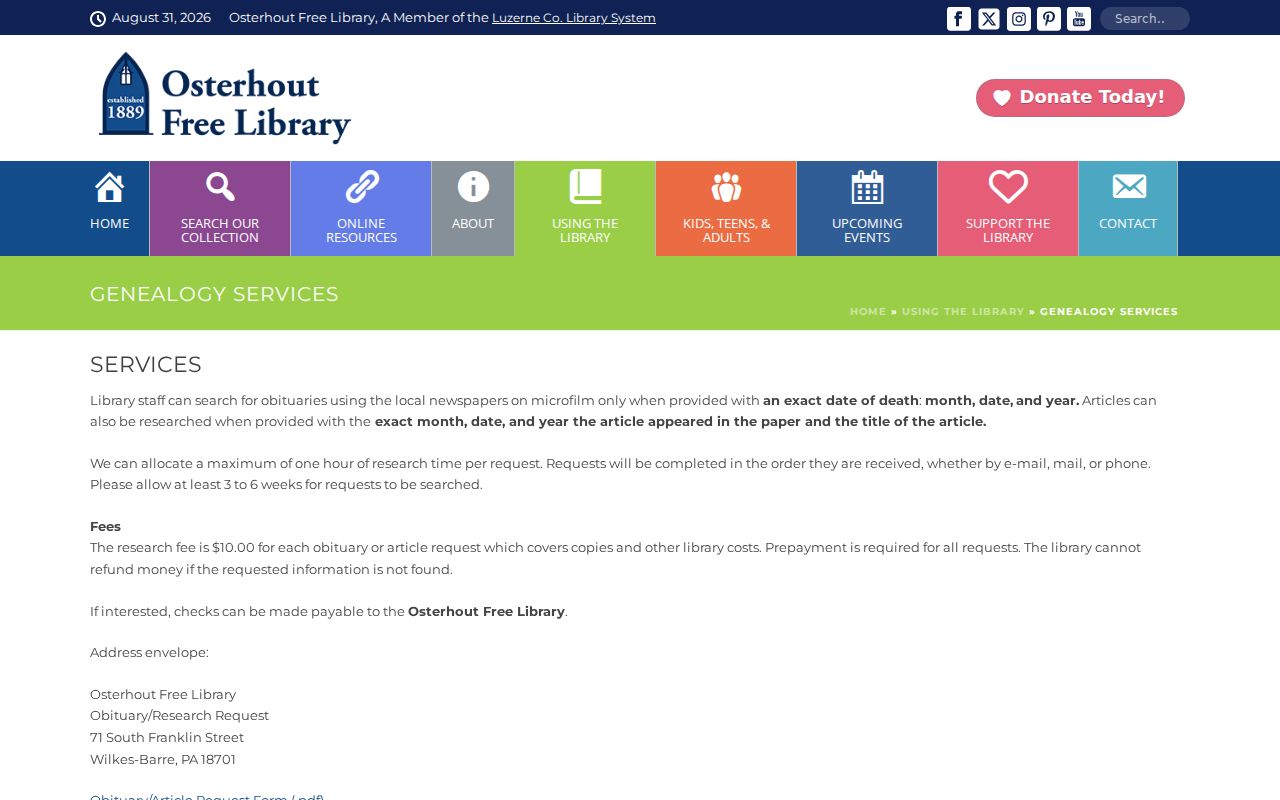
The library page is a useful way to confirm that a local directory route exists before calling about a particular volume, a phone-book shelf, clipping file, or reverse-directory possibility. Its published material does not establish a countywide online reverse-directory database, so access terms should be confirmed with local-history staff.
Luzerne Directories at Bishop Library
The Luzerne County Historical Society research collection holds historic directories from 1871 through 2004, along with maps, atlases, Sanborn material, and head-of-household census indexes for 1800 through 1870. Those companions matter when a directory gives an address but not enough detail to separate two people with the same name. LCHS also describes surname, subject, place, and event indexes that can supply a narrowly focused follow-up lead.
A Bishop Library and Archives visit is appointment-only on Tuesday, Wednesday, Friday, and Saturday, with a call one or two days ahead. Collections do not circulate. Membership admission is free; nonmember adult admission is $5 per day, copies cost 25 cents per page, and scanning or photography requires permission. The library is at 49 S. Franklin Street in Wilkes-Barre, and its published details note stairs and no on-site parking. The Historical Society research-sources page is the collection source shown below.
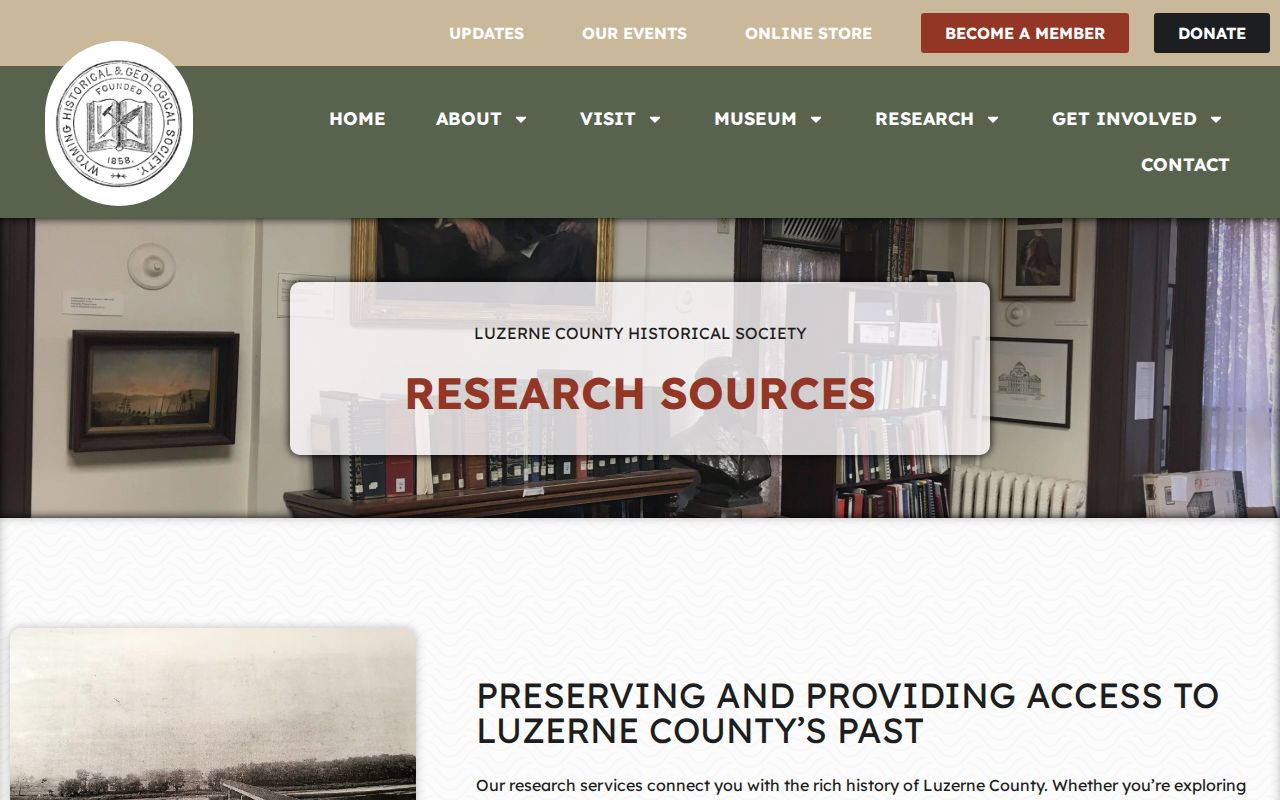
The Historical Society image identifies the local research source behind the longer directory run. Call before a visit with the year, surname, municipality, and whether a map, census index, or clipping file may be needed alongside the volume.
The Bishop inventory also reports more than 13,000 family-surname files, transcriptions of Luzerne County wills from 1787 through 1896, vertical clipping files beginning in the 1800s, and more than 10,000 indexed images. An eight-volume Edward Phillips index provides another local newspaper and history lead. These supporting sources can corroborate a street, surname, local institution, or event after a directory entry identifies a candidate. They should not be used to turn a short printed listing into an unsupported biography.
Reading a Luzerne Directory Entry
LCHS characterizes its directory entries as alphabetical listings much like a phone book. The stated fields are the head of household, spouse, occupation, address of occupation, home address, and sometimes a notation that a woman was widowed. Copy the printed form exactly, including initials and spelling. The fields identify a contemporaneous directory claim, not every person connected to an address or family.
| Head of household | The named person under the alphabetic listing. |
|---|---|
| Spouse or widow notation | A relationship clue that should be checked in another dated record. |
| Occupation | A distinguishing detail when several people share a name. |
| Business and home addresses | Two location clues that may point to different parts of the county. |
| Year of issue | The essential date for comparing the entry to a map, deed, or census. |
- Criss-cross directory
- A directory section arranged by street and address rather than by surname. Luzerne research supports it only for selected volumes.
- Householder index
- An index that points to the named household lead, not a full list of every person at the location.
- Abbreviation key
- The volume's own explanation of shortened terms. Photograph or copy it before interpreting an unusual notation.
Luzerne Street Indexes in Directories
Some LCHS volumes, not all of them, include a street index. That distinction changes an address-first search. Ask for the selected city and year, then ask whether that particular volume has the street index. If it does, locate the house number and street, identify the printed head of household, and then compare the alphabetical listing for the full fields. If it does not, use the alphabetical directory with a ward map, atlas, parcel, or deed clue.
Do not fill the gap by assuming an unverified reverse listing. The By Street route is better for modern parcel and recorded-document work, while these volumes remain dated historical evidence.
Luzerne Film Catalog Access
The FamilySearch catalog entry for Polk's Greater Wilkes-Barre City Directory, 1931 is a collection lead with an important limit: the catalog marks it film only. It lists FamilySearch Library microfilm 1320535, item 2, and DGS 7967989. Film-only status does not mean that the directory can be read remotely. Check the listed access channel before relying on it for a name or address.
This catalog view is useful for identifying the publisher, year, and film reference. Individual FamilySearch material can require a free account, a FamilySearch Center, or an affiliate library, and the 1931 catalog item should never be treated as a digitized home-viewable volume.
Luzerne Directories and 1890
The federal census for 1890 was lost, making Luzerne historical directories especially valuable for the years around that missing schedule. LCHS has census material from 1790 through 1930 and head-of-household indexes for 1800 through 1870; Osterhout also lists Luzerne census microfilm from 1790 through 1930. For the 1880 to 1900 interval, combine a directory with a land, tax, map, newspaper, church, cemetery, or public vital source rather than treating one missing name as an answer.
| 1871 | LCHS city-directory holdings begin. |
|---|---|
| 1884 | Osterhout's Wilkes-Barre run begins. |
| 1890 | The lost federal census increases the value of directory and local-record pairing. |
| 1931 | Polk's Greater Wilkes-Barre catalog entry is film only. |
| 2004 | LCHS's stated city-directory holdings end. |
Newspaper evidence has limits too. LCHS says its historic newspaper microfilm is unindexed and needs a date. Osterhout's obituary search requires a precise death date, is limited to one staff hour, generally takes three to six weeks, and costs $10 even when no item is found.
Luzerne Directory Address Maps
Maps answer a different question from a city directory: they show where an address or structure fit in the surrounding geography. LCHS holds the 1873 Luzerne County atlas, Wilkes-Barre ward maps from 1882, 1894, and 1904, the 1933 Sturdevant Atlas, and Sanborn material for Luzerne communities. The Library of Congress 1891 Wilkes-Barre Sanborn atlas is online in 56 sheets.
Compare the printed street and directory year with the nearest appropriate map, then preserve the ward, map sheet, or lot detail with the name. Maps document building footprints and street context, not occupants. Note: An early Luzerne reference can fall within the county's larger original territory, so historical boundaries may differ from the modern county map.
For pre-1906 events, the Pennsylvania State Archives Luzerne County microfilm guide identifies Recorder deeds from 1787 to 1901, grantor/grantee indexes from 1787 to 1907, Orphans' Court dockets and indexes, county birth and death registrations, and marriage-license dockets. It identifies microfilm coverage, not remote images. That distinction helps choose a custodian before assuming an older name or address can be searched online.
Tracing Luzerne Directory Households
A dated sequence is more reliable than an isolated entry. Begin with a reasonably distinctive surname, initials, community, and year. Write down every spelling, spouse notation, occupation, home address, and business address as printed. The closest released federal census can then test whether the people, place, and date form a plausible match. A directory disappearance can indicate a move, a changed listing form, death, or an omission, so it should send the search to another record instead of ending it.
- Find the earliest relevant Luzerne directory entry and record the complete printed form.
- Read the edition before and after it, noting changes in address, spouse notation, initials, and occupation.
- Check whether the selected volume has a street index, then compare the printed address with its alphabetical entry.
- Pair the directory year with the closest released census and use LCHS's 1800–1870 index when that period fits.
- Use a deed, estate index, dated newspaper item, map, or public vital index to test a move or later event.
For an early land or family reference, keep the county's historical boundary in mind. Luzerne County was created in 1786 and later territory became Lackawanna, Wyoming, Susquehanna, and part of Bradford County. The county history is a useful boundary check before assuming an early record belongs under today's map.